

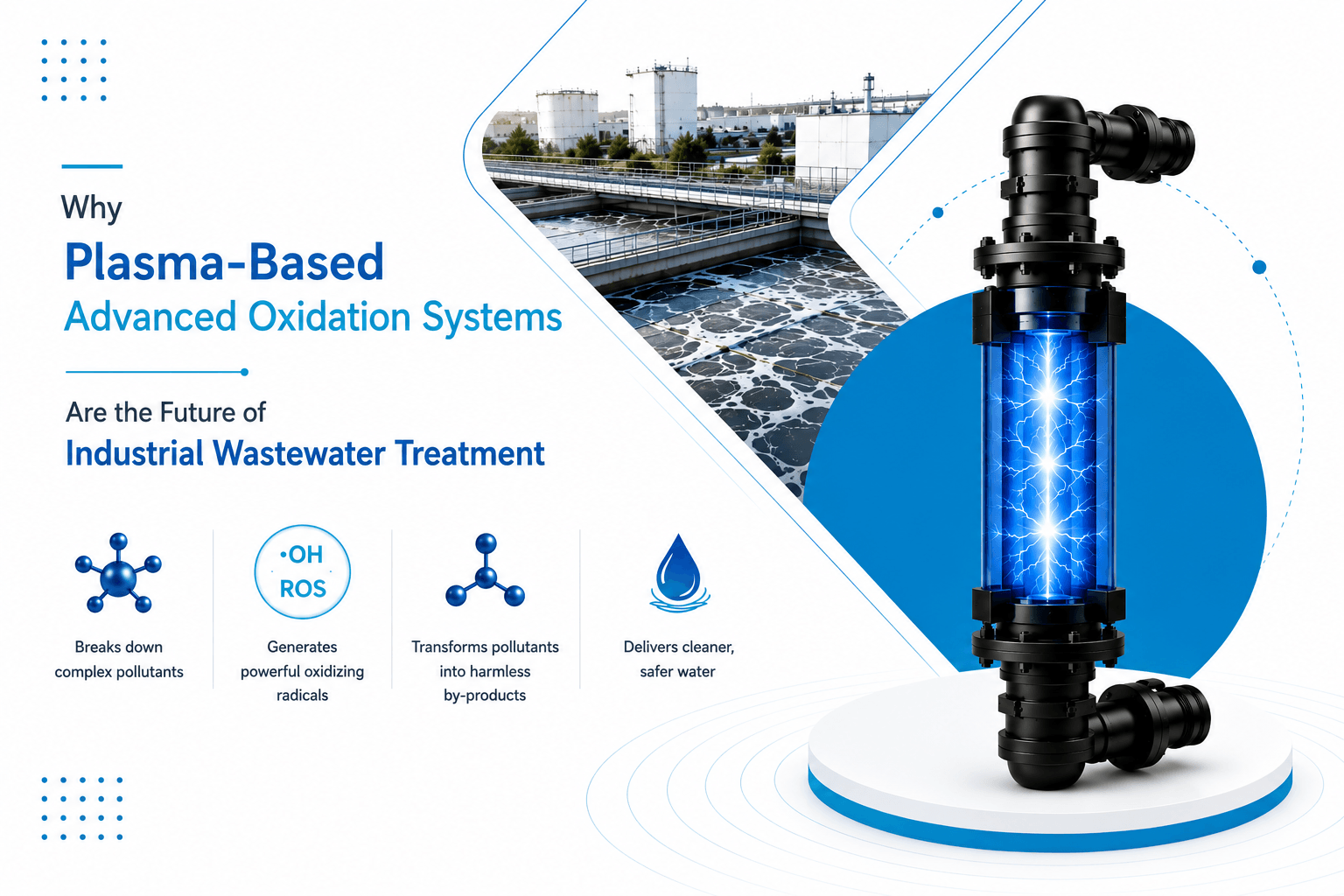
Industrial wastewater treatment is becoming increasingly challenging as manufacturing processes generate more complex and persistent contaminants. Industries such as pharmaceuticals, chemicals, textiles, dyes, food processing, and petrochemicals are producing wastewater that conventional treatment technologies often struggle to treat efficiently.
While biological processes and conventional Chemical Treatment remove a significant portion of pollutants, many facilities continue to face problems with residual COD, elevated TOC in water, colour, trace organics, and low Biodegradability. These issues not only impact compliance but also reduce the efficiency of downstream treatment systems and Zero Liquid Discharge (ZLD) operations.
This is why plasma-based oxidation systems are emerging as one of the most promising innovations in industrial wastewater treatment. Built on the principles of Advanced Oxidation Process (AOP), these systems generate highly reactive oxidation species capable of degrading contaminants that conventional technologies often cannot remove.
In this article, we explore the key benefits of plasma-based oxidation systems, their industrial applications, and why they are shaping the future of water treatment.
What Are Plasma-Based Oxidation Systems?
Plasma-based oxidation systems are advanced treatment technologies that use cold plasma technology to generate highly reactive oxidizing species such as hydroxyl radicals, ozone, hydrogen peroxide, and reactive oxygen species.
These oxidants attack complex organic and inorganic contaminants at the molecular level, making them highly effective for advanced oxidation processes for wastewater treatment.
Unlike conventional oxidation methods that rely heavily on chemicals, plasma systems primarily use electrical energy and ambient air to initiate oxidation reactions. This makes them a powerful and more sustainable option for modern industrial water treatment.
Why Conventional Oxidation Technologies Have Limitations
Traditional oxidation methods such as Ozonation, chlorine dosing, hydrogen peroxide treatment, and UV-based systems are widely used in Effluent Treatment Plants. While effective for many applications, they can present several challenges:
- High chemical consumption
- Storage and handling of hazardous chemicals
- Reduced efficiency against refractory pollutants
- Larger equipment footprint
- Higher operational complexity
As wastewater becomes more difficult to treat, industries require oxidation technologies that are more efficient, flexible, and easier to integrate into existing water treatment systems.
Top Benefits of Plasma-Based Oxidation Systems
1. Superior Oxidation Performance
The greatest advantage of plasma-based oxidation systems is their ability to generate multiple reactive oxidation species simultaneously.
Unlike conventional oxidation methods that depend on a single oxidant, plasma produces a combination of hydroxyl radicals, ozone, atomic oxygen, and other reactive species that work together to degrade complex pollutants.
This significantly improves COD water treatment and the breakdown of refractory organic compounds.
2. Effective Treatment of Refractory Wastewater
Many industrial waste streams contain contaminants that resist biological degradation.
These include pharmaceutical residues, synthetic dyes, aromatic hydrocarbons, solvents, and petrochemical compounds.
By generating powerful oxidants, advanced oxidation helps convert these stable molecules into simpler compounds that are easier to remove during downstream treatment.
This also improves wastewater biodegradability, allowing biological systems to perform more efficiently.
3. Better COD and TOC Reduction
Residual COD and elevated TOC in water remain major challenges for industrial facilities.
Plasma-based oxidation systems are particularly effective for:
- COD water treatment
- TOC water treatment
- Color removal
- Odour reduction
Reducing the organic load before tertiary treatment helps improve the performance of membranes, biological reactors, and polishing units.
4. Reduced Chemical Dependency
Unlike conventional oxidation processes that require continuous dosing of oxidizing chemicals, plasma systems rely primarily on electrical energy.
Benefits include:
- Lower chemical consumption
- Reduced storage requirements
- Improved operator safety
- Lower risk of chemical handling
This makes plasma a more sustainable solution for modern industrial water treatment systems.
5. Supports Zero Liquid Discharge (ZLD)
Industries investing in zero liquid discharge need efficient upstream treatment to protect expensive downstream equipment.
Integrating AOP treatment before reverse osmosis and evaporation can help:
- Reduce membrane fouling
- Improve water recovery
- Lower evaporator load
- Reduce operational costs
As a result, plasma technology supports more efficient zero liquid discharge technology and ZLD water treatment.
6. Improves Tertiary Treatment Performance
Many facilities use plasma as part of the tertiary treatment of wastewater.
Installing plasma oxidation after biological treatment enhances the removal of residual pollutants before:
- Reverse osmosis
- Activated carbon
- Membrane filtration
- Water reuse systems
This improves the quality of treated water while reducing stress on downstream processes.
7. Compact, Modular and Easy to Integrate
One of the biggest advantages of modern plasma systems is their modular design.
Unlike conventional oxidation units that often require significant infrastructure, plasma-based systems can be integrated into existing industrial effluent treatment plants with minimal disruption.
Their compact footprint makes them suitable for both pilot-scale and full-scale deployment.
8. Supports Industrial Water Reuse
Water scarcity and regulatory pressure are encouraging industries to adopt water recycling systems.
By improving wastewater quality before membrane treatment, plasma oxidation enables greater water recovery and supports sustainable reuse strategies.
This contributes to lower freshwater consumption and improved environmental performance.
9. Applications Beyond Wastewater
Although widely used in industrial wastewater treatment, plasma oxidation also has applications in drinking water treatment.
It can assist in:
- Arsenic removal from water
- Iron oxidation
- Manganese oxidation
- Taste and odour control
- Pre-treatment before filtration
These capabilities make plasma a versatile solution for both industrial and municipal water treatment.
How Sustainyx is Advancing Plasma-Based Water Treatment
Turning advanced science into practical industrial solutions requires more than innovative technology; it requires systems engineered for real-world deployment.
SustainyX, part of the SFC Group, has developed the C-ION™ platform to bring Advanced Oxidation Process into modular, scalable treatment systems.
Powered by PlasmaConnect™, the platform uses cold plasma technology to generate reactive oxidation species that help industries address complex treatment challenges, including:
- Residual COD water treatment
- TOC water treatment
- Zero Liquid Discharge optimisation
- Industrial wastewater treatment
- Arsenic removal from water
- Enhanced tertiary treatment of wastewater
Designed as plug-and-play industrial water treatment systems, SustainyX solutions can be integrated into existing treatment infrastructure, helping industries improve compliance, operational efficiency, and long-term sustainability.
Conclusion
As industrial wastewater becomes increasingly complex, treatment technologies must evolve beyond conventional oxidation methods.
Plasma-based oxidation systems provide industries with a powerful solution for tackling difficult contaminants, improving COD water treatment, enhancing Biodegradability, supporting Zero Liquid Discharge, and enabling more efficient water recycling systems.
By combining Advanced Oxidation Process with modular engineering, SustainyX’s C-ION™ platform powered by PlasmaConnect™ demonstrates how advanced science can be transformed into practical, scalable solutions for modern water treatment. For industries looking to improve compliance, optimise operations, and prepare for the future of water reuse, plasma-based oxidation offers a compelling path forward.
FAQs
What is a plasma-based oxidation system?
A plasma-based oxidation system uses cold plasma technology to generate highly reactive oxidation species that break down difficult contaminants in water and wastewater.
How is plasma different from ozonation?
While Ozonation primarily relies on ozone as the oxidant, plasma generates multiple reactive species simultaneously, providing stronger oxidation for many difficult industrial waste streams.
Can plasma reduce COD and TOC?
Yes. Plasma oxidation is highly effective for COD water treatment and TOC water treatment, particularly where biological treatment reaches its limitations.
Is plasma suitable for Zero Liquid Discharge plants?
Yes. Plasma systems improve upstream treatment, making Zero Liquid Discharge systems more efficient by reducing membrane fouling and lowering the load on evaporation systems.
Which industries benefit most from plasma oxidation?
Industries including pharmaceuticals, chemicals, petrochemicals, textiles, food processing, and specialty chemicals benefit significantly from plasma-based oxidation systems because of their ability to treat refractory wastewater.