

Industrial wastewater is becoming increasingly difficult to treat. Across sectors such as pharmaceuticals, chemicals, textiles, dyes, and petrochemicals, wastewater now contains complex pollutants that conventional treatment systems often find difficult to treat completely.
Even after biological treatment, many facilities continue to struggle with residual COD, elevated TOC levels, colour, dissolved metals, and refractory organics. These contaminants reduce treatment efficiency, increase operating costs, and make regulatory compliance more challenging.
This is where advanced oxidation based on non-thermal plasma for wastewater treatment is emerging as a promising advanced oxidation technology.
By combining the power of plasma oxidation with advanced oxidation process (AOP) principles, non-thermal plasma enables the treatment of difficult wastewater streams that conventional systems cannot effectively handle.
In this blog, we explain how plasma technology in water treatment works, why it matters, and how companies like SustainyX are helping industries adopt this next-generation treatment solution.
What is Non-Thermal Plasma?
Plasma is often called the fourth state of matter, after solid, liquid, and gas. When sufficient energy is applied to a gas, it becomes ionized, producing a mixture of electrons, ions, reactive radicals, excited species, and charged particles. This ionized state is known as plasma.
There are two main types of plasma:
- Thermal Plasma
In thermal plasma, electrons and heavy particles reach similar temperatures, resulting in extremely high heat.
- Non-Thermal Plasma
In non-thermal plasma, electrons carry high energy while the surrounding gas remains near ambient temperature.
This enables powerful chemical reactions without excessive heat generation. That is why non-thermal plasma is ideal for water treatment applications.
How Does Non-Thermal Plasma Work in Wastewater Treatment?
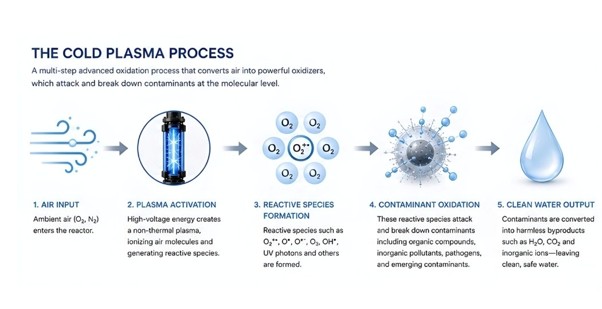
The working principle of non-thermal plasma wastewater treatment is to generate highly reactive oxidizing species that degrade pollutants.
The process can be broken into five stages.
1. Electrical Energy Generates Plasma
A controlled electrical discharge is applied to air, oxygen, or another gas medium. This creates plasma containing energetic electrons. These electrons collide with gas molecules, producing reactive species.
2. Reactive Oxidants Are Formed
The plasma generates powerful oxidizing species, such as:
- Hydroxyl radicals (•OH)
- Ozone (O₃)
- Hydrogen peroxide (H₂O₂)
- Atomic oxygen
- Reactive nitrogen species
These reactive oxygen and nitrogen species (RONS) contribute to the oxidation and degradation of organic and inorganic contaminants.
Hydroxyl radicals are especially important because they are among the strongest oxidants used in water treatment.
3. Oxidants Attack Pollutants
Once generated, reactive species attack contaminants in wastewater. They attack carbon-carbon bonds, aromatic rings, complex organic structures, and other recalcitrant organic compounds.
This makes plasma highly effective for COD reduction, TOC reduction, Colour removal, Odour control, and Toxic compound degradation
4. Complex Pollutants Break into Simpler Molecules
Many industrial pollutants resist biological degradation.
Examples include: Dyes, Phenols, Solvents, Pharmaceutical residues, and Petrochemical compounds
Plasma oxidation breaks these complex molecules into smaller intermediates, which may subsequently undergo further oxidation or biodegradation.
This improves downstream treatment efficiency.
5. Downstream Systems Perform Better
Once refractory pollutants are broken down, downstream treatment becomes easier.
This improves the performance of:
- Biological treatment systems
- Reverse osmosis units
- Tertiary polishing systems
- Evaporators in ZLD plants
This is why non-thermal plasma is being explored as a pre-treatment technology for improving ZLD system performance.
Why Conventional Systems Struggle
Traditional wastewater treatment systems are designed mainly for biodegradable pollutants.
Typical processes include:
- Primary settling
- Biological treatment
- Coagulation/flocculation
- Membrane filtration
These methods work well for conventional wastewater. However, modern industrial wastewater often contains persistent compounds that:
- Resist biodegradation
- Survive multiple treatment stages
- Cause residual COD
- Increase membrane fouling
- Reduce water reuse efficiency
This creates a treatment gap. Advanced oxidation process for wastewater fills that gap.
Key Benefits of Non-Thermal Plasma in Water Treatment
1. High Efficiency in COD Reduction
One major advantage of plasma technology in water treatment is reduction of refractory organic compounds contributing to residual COD. It targets contaminants that biological systems cannot remove.
2. Effective TOC Reduction
TOC reduction can improve treated water quality and reduce membrane fouling potential in downstream systems.
3. Lower Chemical Dependency
Unlike conventional oxidation systems, plasma can significantly reduce chemical usage. This lowers: Chemical handling, Storage requirements & Operating complexity.
4. Better ZLD Performance
For plants running Zero Liquid Discharge (ZLD) systems, plasma can reduce pollutant load before RO, MEE, ATFD, and Crystallizers
This improves recovery and lowers energy consumption.
5. Modular Deployment
Modern plasma water treatment systems can be deployed in compact, modular configurations.
Non-Thermal Plasma vs Conventional Oxidation
| Parameter | Conventional Oxidation | Non-Thermal Plasma |
| Chemical Dependency | High | Low |
| Oxidation Strength | Moderate | Very High |
| Complex Pollutant Removal | Limited | Excellent |
| Footprint | Large | Compact |
| Scalability | Moderate | High |
This comparison explains why plasma-based AOP is attracting attention worldwide.
How Sustainyx is Making Plasma Treatment Practical
While the science behind plasma is advanced, adoption depends on practical engineering. This is where SustainyX brings real-world value.
Sustainyx is a next-generation water technology platform delivering modular, high-performance systems for industrial and municipal treatment, bridging breakthrough R&D with deployment-ready engineered products.
Built on C-ION™ technology platform, using non-thermal plasma for wastewater treatment PlasmaConnect™ is a modular advanced oxidation process system designed for real industrial challenges.
PlasmaConnect™ is built to address:
- Residual COD & TOC reduction
- Difficult refractory wastewater treatment
- ZLD optimization
- Dissolved metal oxidation
- Advanced drinking water treatment, including arsenic oxidation
Unlike conventional large-footprint systems, PlasmaConnect™ offers:
- Plug-and-play deployment
- Modular scalability
- Low operational complexity
- Easier integration into existing treatment infrastructure
This makes advanced oxidation more accessible to industries seeking compliance, efficiency, and long-term sustainability.
Conclusion
As wastewater becomes more complex, traditional treatment systems alone are no longer sufficient.
Industries need treatment technologies that can address the fraction that conventional systems cannot remove.
That is exactly where non-thermal plasma wastewater treatment delivers value.
By generating highly reactive oxidizing species, plasma enables efficient COD reduction, improved TOC reduction, better ZLD optimization, and stronger overall industrial wastewater treatment performance.
With innovations like C-ION™ and PlasmaConnect™, advanced oxidation is moving from laboratory science to practical, scalable industrial deployment.
The future of wastewater treatment will not just be about treating more water – it will be about treating difficult water smarter.
FAQ’s
1. Is non-thermal plasma safe for water treatment?
Yes. When engineered correctly, non-thermal plasma systems are safe and highly effective for industrial and municipal water treatment.
2. Can plasma reduce COD?
Plasma-based oxidation is highly effective for COD reduction, especially for non-biodegradable organics.
3. Is plasma useful for ZLD systems?
Plasma improves ZLD optimization by reducing pollutant load before high-energy downstream units.
4. Is plasma better than ozone?
It depends on the application. Plasma can generate multiple oxidants simultaneously, often delivering stronger oxidation performance for complex wastewater.