

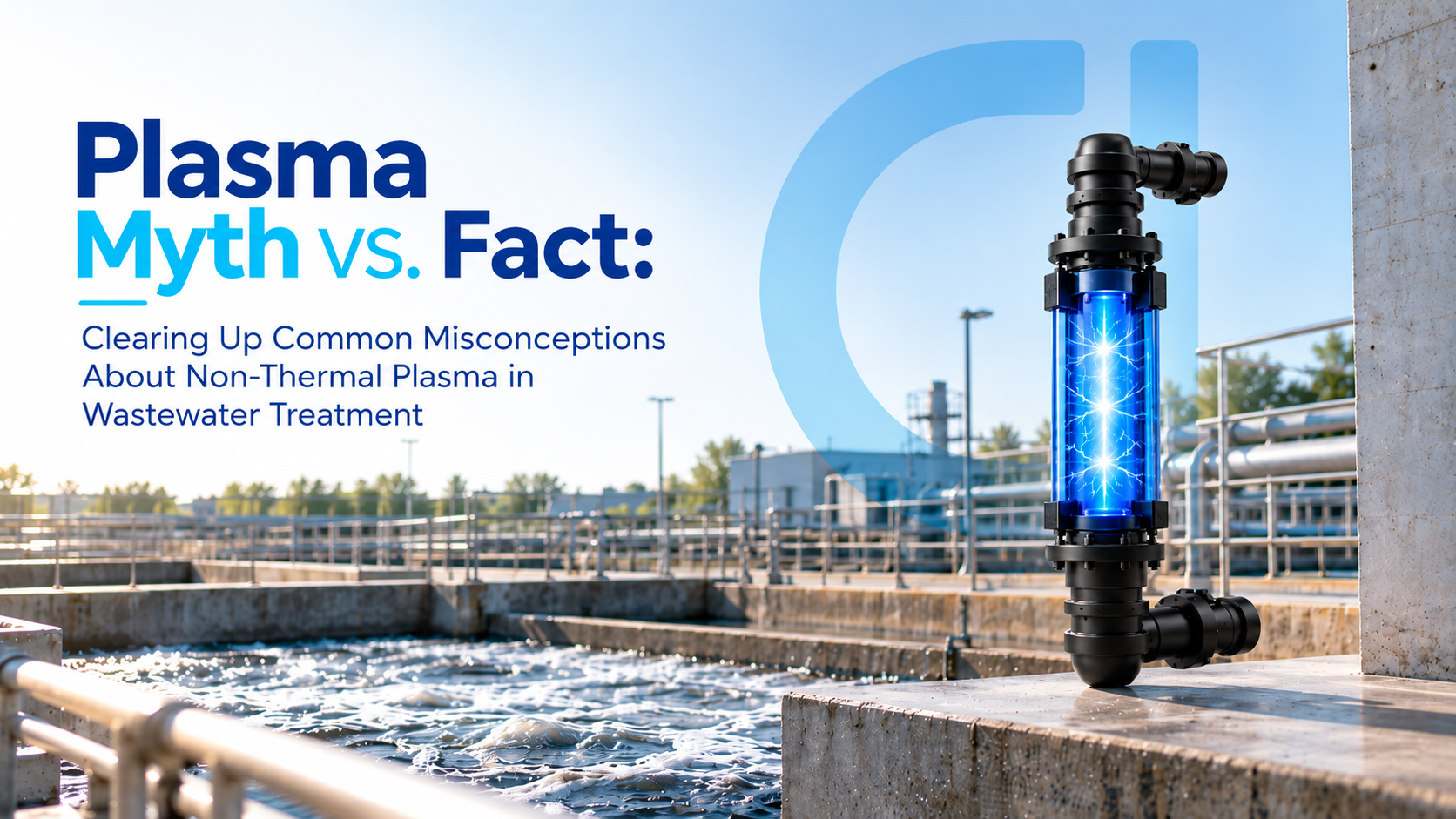
As industries face stricter environmental regulations and growing pressure to recycle water, the demand for advanced wastewater treatment technologies continues to rise. One technology gaining increasing attention is non-thermal plasma.
Despite its potential, many people still have questions about how it works and where it fits into industrial wastewater treatment. Let’s take a closer look at some common myths and the facts behind them.
Myth 1: Plasma treatment is only useful in research laboratories.
Fact:
While non-thermal plasma was initially developed in research settings, it has now progressed well beyond the laboratory. Today, it is being evaluated through pilot-scale systems and applied to challenging industrial wastewater streams, including pharmaceutical, chemical, textile, and leachate applications.
Pilot studies help industries assess real-world performance, optimize operating conditions, and determine whether the technology is suitable before moving to full-scale implementation.
Myth 2. “It’s a standalone magic bullet.”
Fact:
No single technology solves 100% of a complex wastewater puzzle. Plasma’s real superpower isn’t replacing everything; it’s generating high-powered reactive species right inside the water to shatter complex, recalcitrant organics. It breaks non-biodegradable compounds down into forms that downstream biological systems can digest. Think of it as the ultimate setup hitter, not the whole team.
This can reduce color, improve biodegradability, and enhance the efficiency of downstream treatment processes.
However, treatment performance depends on several factors, including:
- Wastewater characteristics
- Initial COD concentration
- pH
- Conductivity
- Retention time
- Overall treatment process design
In many cases, plasma performs best when integrated with biological or conventional treatment systems rather than being used as a standalone solution.
Myth 3: Plasma treatment always requires large amounts of chemicals.
Fact:
One of the advantages of non-thermal plasma is that it generates reactive oxidative species directly within the reactor using electrical energy.
Depending on the treatment objective and system design, plasma can often operate with little or no additional chemicals, reducing chemical handling, storage requirements, and sludge generation compared to some conventional oxidation processes.
Myth 4: If the wastewater becomes clear, the treatment is complete.
Fact:
Clear water does not always mean clean water.
Clear water is a dangerous vanity metric. Stripping out color-causing molecules is often the easy part. Invisible recalcitrant organics, active pharma residues, or trace toxicity can still lurk in visual clear water. True performance must always be validated against hard metrics: COD, TOC, BOD, toxicity, and biodegradability ratios.
Myth 5: Plasma can replace every other wastewater treatment process.
Fact:
Non-thermal plasma is not intended to replace every treatment technology.
Instead, it is often most effective when used as part of an integrated treatment train. By breaking down complex organic compounds and reducing toxicity, plasma can improve the performance of downstream biological treatment and help increase overall treatment efficiency.
The right treatment solution always depends on the characteristics of the wastewater and the desired treatment goals.
Myth 6: Advanced oxidation technologies consume too much energy to be practical.
Fact:
Like any treatment process, energy consumption depends on the wastewater characteristics, treatment objectives, and system design.
Modern plasma systems are designed to operate efficiently, and pilot studies play an important role in identifying operating conditions that balance treatment performance with energy consumption before full-scale implementation.
Myth 7: Plasma treatment is only suitable for one industry.
Fact:
Non-thermal plasma has potential applications across a wide range of industries, including:
- Pharmaceutical manufacturing
- Chemical processing
- Textile industries
- Landfill leachate treatment
- Food and beverage processing
- Petrochemicals
- Dyes and pigments
Since every wastewater stream is unique, pilot testing helps determine how technology can be best integrated into an existing treatment system.
Beyond the Myths
As industries work toward stricter discharge standards, water reuse, and more sustainable operations, advanced oxidation technologies are becoming an increasingly valuable part of modern wastewater treatment.
Non-thermal plasma offers a promising approach for treating pollutants that are difficult to remove using conventional methods. When thoughtfully integrated into an overall treatment strategy, it can enhance process performance and support more efficient wastewater management.
Final Thoughts
Like any technology, non-thermal plasma is not a universal solution, but it is a powerful tool when applied to the right challenge.
Understanding both its capabilities and its limitations is essential for designing effective treatment systems. Pilot studies and careful process evaluation help ensure that industries achieve reliable, efficient, and sustainable treatment outcomes.
At Sustainyx Smart Solutions, we believe that every wastewater stream deserves a solution tailored to its unique characteristics. Through pilot studies and advanced oxidation technologies like PlasmaConnect, we work with industries to develop treatment strategies that are practical, effective, and future-ready.
FAQs
What is non-thermal plasma in wastewater treatment?
Non-thermal plasma is an advanced oxidation technology that uses electrical energy to generate highly reactive species capable of oxidising and breaking down persistent organic contaminants. It can be used as part of industrial wastewater treatment for challenging pollutants that may be difficult to address through conventional processes alone.
How does non-thermal plasma help with industrial wastewater treatment?
Non-thermal plasma can support industrial wastewater treatment by generating reactive oxidative species that attack complex and refractory organic compounds. Depending on the wastewater characteristics and process configuration, it can support COD reduction, TOC reduction, colour removal and improved biodegradability as part of an integrated treatment system.
Is non-thermal plasma a chemical-free water treatment technology?
Non-thermal plasma can operate with low chemical dependency because reactive species are generated using electrical energy within the treatment system. However, whether additional chemicals are required depends on the wastewater characteristics, treatment objectives and overall water treatment system design. It is therefore more appropriate to describe it as a low-chemical oxidation technology rather than universally chemical-free.
Can non-thermal plasma replace conventional wastewater treatment processes?
No. Non-thermal plasma is not intended to replace every wastewater treatment process. It is often used as an Advanced Oxidation Process (AOP) within an integrated treatment train, where it can help break down persistent contaminants and improve the performance of downstream biological or tertiary treatment processes.
What types of wastewater can be treated using non-thermal plasma?
Non-thermal plasma has potential applications across several industrial wastewater treatment sectors, including pharmaceutical wastewater, chemical effluent, textile and dye wastewater, landfill leachate and other challenging industrial streams. Pilot testing is important for determining the appropriate AOP water treatment configuration and operating conditions for each wastewater.