

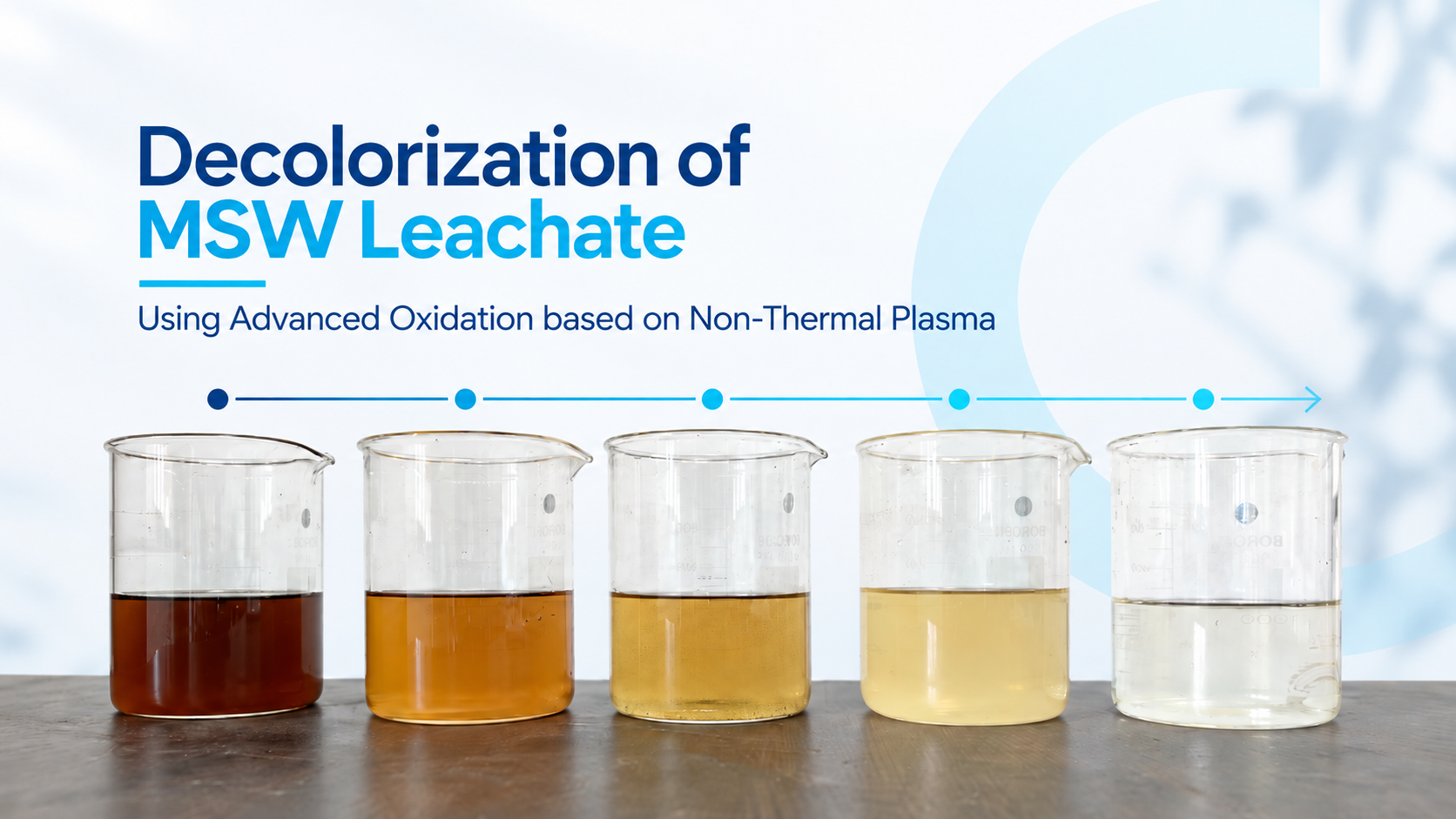
One of the most visible observations from our pilot-scale study was the clear reduction in the colour of Municipal Solid Waste (MSW) leachate following Non-Thermal Plasma (NTP) treatment.
The characteristic dark brown appearance of the leachate became noticeably lighter after treatment.
This observation raises an interesting question: what causes the colour of leachate, and what can its reduction tell us about the treatment process?
Why Is MSW Leachate Dark Brown?
The dark brown colour of mature MSW leachate is commonly associated with humic substances, fulvic substances and other dissolved organic matter containing chromophoric structures.
These compounds can contain aromatic and conjugated structures that absorb visible light, contributing to the characteristic dark colour of leachate.
Some of this organic matter can also be relatively resistant to conventional biological treatment. As a result, colour and a fraction of dissolved organic matter may remain after biological treatment, depending on the characteristics of the leachate and the treatment process.
How Can Non-Thermal Plasma Contribute to Decolorization?
Non-Thermal Plasma creates a reactive treatment environment in which oxidising species can be generated in situ.
Depending on the plasma configuration and operating conditions, these may include hydroxyl radicals (•OH), ozone (O₃), hydrogen peroxide (H₂O₂) and other reactive species.
These species can interact with organic molecules through different oxidation reactions and may alter the structures responsible for colour.
A simplified representation is:
Chromophoric Organic Compounds → Reactive Species Interaction → Transformation of Colour-Causing Structures → Oxidation Products
The exact reaction pathways depend on the wastewater composition and operating conditions of the plasma system.
Why Does the Colour Decrease?
The colour of leachate is related to molecular structures that absorb visible light.
When reactive species interact with these chromophoric structures, their chemical structure can be altered, potentially reducing their ability to absorb visible light.
The result can be a visible reduction in colour.
Therefore, the change from dark brown to a lighter appearance provides an indication that colour-associated compounds or their chromophoric structures have been transformed during treatment.
However, an important distinction needs to be made:
Decolorization does not necessarily mean complete degradation or mineralization of the organic matter.
Some oxidation intermediates may remain even after substantial colour reduction. For this reason, colour should be considered alongside other water-quality parameters when evaluating treatment performance.
What Did We Observe During the Pilot Study?
During our pilot-scale evaluation, we observed a clear reduction in the characteristic dark colour of the MSW leachate after Non-Thermal Plasma treatment.
This observation is consistent with the interaction of plasma-generated reactive species with colour-associated organic compounds.
However, visual observation alone cannot determine the extent of overall organic degradation.
A more complete assessment can include parameters such as:
- COD
- TOC
- UV-Vis absorbance
- Biodegradability
- Specific organic contaminants, where relevant
These measurements help distinguish between decolorization and broader changes in the organic content of the wastewater.
Why Is This Relevant to Leachate Treatment?
MSW leachate is a complex wastewater stream, and its composition can vary with factors such as waste characteristics, landfill age and operating conditions.
It may contain both biodegradable and relatively refractory organic compounds.
Conventional treatment processes can address many of these constituents, but the treatment outcome depends on the specific characteristics of the leachate.
Non-Thermal Plasma can therefore be considered as an additional oxidation step within a broader treatment strategy.
Depending on the treatment objective, possible configurations may include:
Pre-treatment → Plasma AOP → Biological Treatment
or:
Biological Treatment → Plasma AOP → Polishing
The appropriate position of plasma treatment needs to be determined based on wastewater characteristics, treatment objectives and experimental evaluation.
Beyond Decolorization: Why Validation Matters
The reduction in colour observed during our pilot study is an important and visible treatment response.
However, the more important questions are:
What happened to the organic matter?
Were refractory compounds transformed?
How did COD and TOC change?
Did the treatment affect biodegradability?
These questions cannot be answered through colour reduction alone.
Systematic analysis of multiple treatment parameters is therefore essential for understanding the overall effect of Non-Thermal Plasma on MSW leachate.
This is also why pilot-scale testing is valuable. Real leachate can behave differently from synthetic or laboratory-prepared wastewater, and treatment performance needs to be evaluated under actual operating conditions.
Exploring Non-Thermal Plasma for Refractory Wastewater
The observed decolorization of MSW leachate provides an indication of the interaction between plasma-generated reactive species and colour-associated organic compounds.
It also highlights the potential for Non-Thermal Plasma to be evaluated as an Advanced Oxidation Process (AOP) for challenging wastewater streams.
However, the suitability and effectiveness of the technology should be established through wastewater characterisation, controlled experiments and pilot-scale validation rather than colour reduction alone.
At SustainyX, we are exploring plasma-based advanced oxidation for complex wastewater applications where additional treatment may be required alongside conventional processes.
Our approach is to understand the treatment mechanism, measure the actual changes in wastewater quality, and evaluate where plasma-based oxidation can add value within an overall treatment train.
Key Takeaway
The reduction in colour is what we can see. The real question is what chemical changes are taking place behind that visible transformation.
For Non-Thermal Plasma to become a reliable wastewater-treatment solution, those changes need to be measured, understood and validated under real wastewater conditions.
FAQs
Why is municipal solid waste (MSW) leachate dark brown in colour?
Municipal solid waste (MSW) leachate is often dark brown due to dissolved organic matter, including humic and fulvic substances. These compounds contain light-absorbing molecular structures called chromophores, which contribute to the leachate’s characteristic colour.
How does non-thermal plasma remove colour from MSW leachate?
Non-thermal plasma can generate reactive species, including hydroxyl radicals and other oxidising species, that interact with colour-causing organic compounds. These reactions can alter chromophoric structures and reduce visible colour. The extent of decolorization depends on the leachate composition and plasma operating conditions.
Does colour reduction in leachate mean that COD and TOC have also decreased?
Can non-thermal plasma be used as an advanced oxidation process for landfill leachate treatment?
Yes. Non-thermal plasma can be evaluated as an Advanced Oxidation Process (AOP) for landfill leachate treatment, particularly where additional oxidation of persistent organic compounds is required. Its effectiveness and the best treatment configuration should be established through laboratory analysis and pilot-scale testing.
How can the effectiveness of non-thermal plasma treatment for MSW leachate be measured?
Treatment effectiveness can be assessed using multiple parameters, including COD, TOC, UV-Vis absorbance, colour, biodegradability and selected organic contaminants. Comparing untreated and treated samples helps determine whether visible decolorization is accompanied by measurable improvements in wastewater quality.