

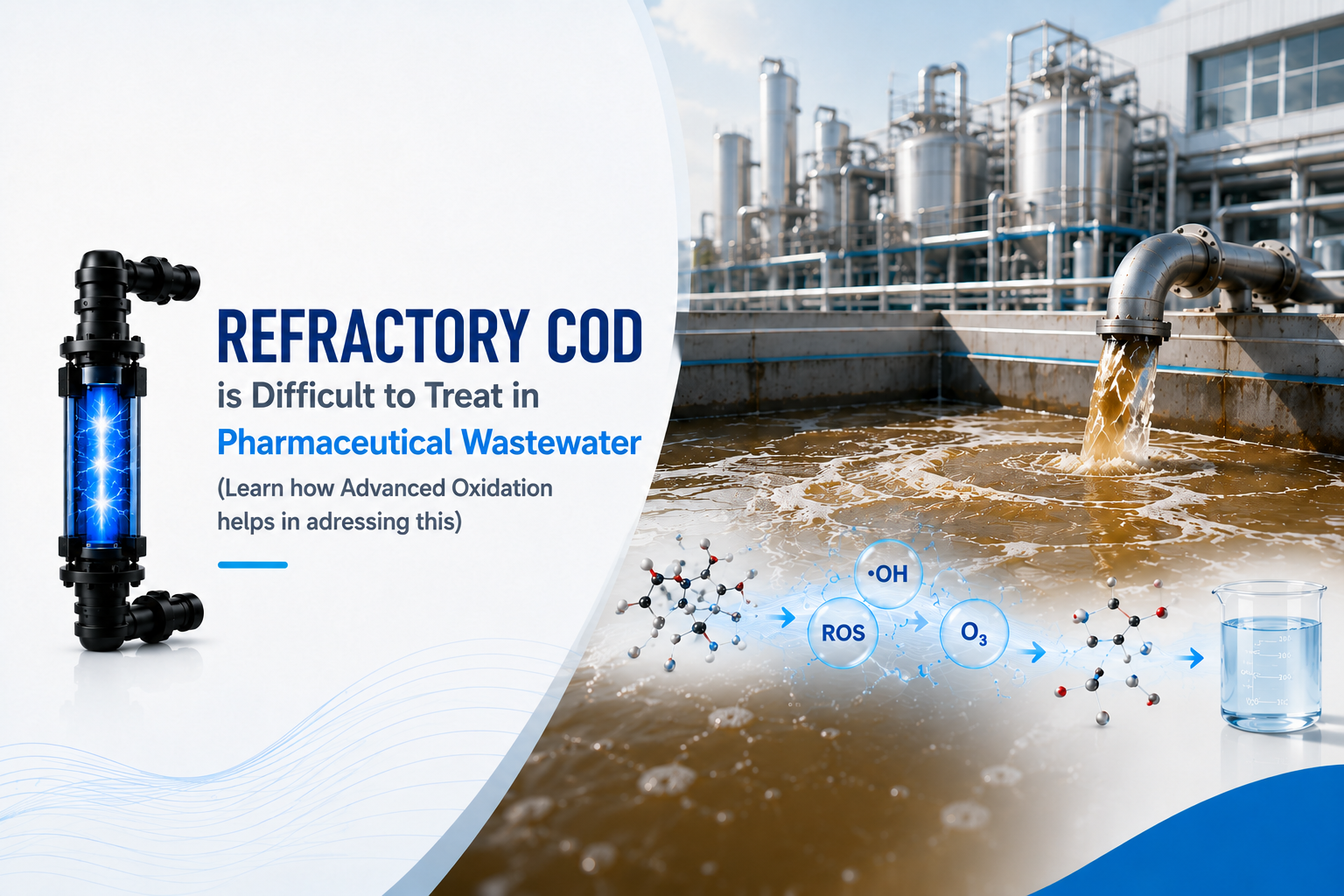
The pharmaceutical industry generates complex industrial effluents containing active pharmaceutical ingredients (APIs), solvents, antibiotics, intermediates, dyes, and surfactants.
While modern Effluent Treatment Plants (ETPs) remove biodegradable organic matter, pharmaceutical facilities routinely struggle with refractory Chemical Oxygen Demand (COD). This persistent fraction drives up operating costs (OPEX), causes inconsistent discharge quality, and damages downstream treatment units.
As environmental regulations tighten and industries transition towards Zero Liquid Discharge (ZLD), addressing refractory organics is a top operational priority. This white paper explores what refractory COD is, why standard biological systems fail to decompose it, and how Non-Thermal Plasma (NTP) technology bridges the gap.
What is refractory COD?
Chemical Oxygen Demand (COD) measures the oxygen required to chemically oxidize organic matter in wastewater. In process engineering, COD is split into two major fractions:
- Biodegradable COD (bCOD): Organics that microorganisms readily metabolize during biological treatment.
- Non-Biodegradable / Refractory COD (nbCOD): Organic molecules whose chemical structures resist microbial enzymatic cleavage, passing through standard biological treatment stages virtually unchanged.
- In pharmaceutical wastewater, persistent refractory compounds accumulate in recirculating loops and reduce plant efficiency. Common examples include:
- Active Pharmaceutical Ingredients (APIs): Recalcitrant antibiotic residues (e.g., beta-lactams, macrolides) and cytotoxic drugs engineered for biological stability.
- Aromatic & Chlorinated Organics: Phenols, nitrobenzenes, chlorinated solvents, and complex intermediate ring structures.
- Synthetic Additives & Surfactants: High-molecular-weight additives, emulsifiers, and persistent dye compounds causing lingering color.
Why Pharmaceutical Wastewater Contains High Refractory COD
Pharmaceutical manufacturing relies on multi-step chemical synthesis designed to yield biologically stable molecules. Key technical factors leading to elevated refractory COD include:
1. High Molecular Stability: Strong covalent bonds, aromatic rings, and halogenated functional groups (e.g., C–Cl linkages) resist natural enzymatic breakdown.
2. Low Biodegradability Index (BOD₅/COD < 0.2–0.3): Conventional biological treatment requires a ratio ≥ 0.4. Ratios below 0.2 induce microbial stasis or toxicity in activated sludge biomass.
3. High Soluble Residual Organics: Dissolved Total Organic Carbon (TOC) passes uninhibited through primary clarifiers and secondary bioreactors, requiring tertiary intervention.
4. Campaign-Based Production & Toxic Shock Loads: Variable production cycles generate sudden surges in organic load and toxic APIs, causing biological reactor upsets.
Why Conventional ETPs Struggle to Remove Refractory COD
A standard effluent treatment plant generally consists of the following:
- Equalization
- Neutralization
- Primary clarification
- Biological treatment
- Secondary clarification
- Tertiary polishing
These systems perform well for biodegradable pollutants. However, they are not designed to remove highly stable organic molecules. Typical challenges include the following:
- Residual COD
- High TOC
- Persistent colour
- Toxic intermediates
- Poor biodegradability
- Increased membrane fouling
As a result, many pharmaceutical plants experience a COD plateau after biological treatment, where further reductions become difficult despite increased aeration or chemical dosing.
Impact on Zero Liquid Discharge (ZLD) Systems & NTP Plasma Intervention
Facilities operating with ZLD systems depend heavily on upstream organic removal. When unoxidized refractory COD flows into downstream membrane filtration and thermal concentration units, severe operational issues arise. Integrating Non-Thermal Plasma (NTP) oxidation directly mitigates these risks:
| ZLD Unit Operation | Impact of Unremoved Refractory COD | How NTP Plasma Pre-Treatment Mitigates Risk |
| Reverse Osmosis (RO) Membranes | Organic molecules cause irreversible biofouling, increasing operating pressure and forcing frequent Clean-In-Place (CIP) cycles. | Breaks complex ring structures into smaller, less-fouling organic fragments, helping maintain membrane flux. |
| Thermal Evaporators (MVR / MEE) | Soluble refractory organics alter surface tension, causing severe foaming, organic carryover, and emergency shutdowns. | Oxidizes foam-causing surfactants and dissolved organics, supporting stable boiling dynamics. |
| Crystallizers & Salt Byproducts | Residual organics co-crystallize with inorganic salts, creating hazardous, highly contaminated mixed salt waste. | Significantly degrades residual organic carbon to produce cleaner salt output and minimize hazardous waste costs. |
Why Advanced Oxidation Process is an Effective Solution
Advanced Oxidation Processes bypass biological limitations by generating non-selective, highly reactive species – primarily Hydroxyl Radicals (•OH). Possessing a high standard reduction potential (E° = 2.80 V), hydroxyl radicals attack recalcitrant molecules at diffusion-controlled reaction speeds (k = 10⁷ to 10¹⁰ M⁻¹s⁻¹).
Dual Operational Pathways of AOP:
· Pathway 1: Partial Oxidation (Pre-Treatment): Cleaves aromatic rings and complex polymers into oxygenated, bio-accessible intermediates (e.g., carboxylic acids). This elevates the BOD₅/COD ratio from < 0.2 to > 0.4, enabling downstream biological treatment.
· Pathway 2: Targeted Degradation (Tertiary Polishing): Destroys residual refractory organics prior to RO membranes, preventing downstream fouling.
The Emerging Role of Cold Plasma Technology
One of the most promising developments in AOP technologies is non-thermal plasma / cold plasma technology.
Unlike conventional oxidation methods that rely heavily on chemicals, cold plasma generates reactive oxidation species using electrical energy and ambient air.
Benefits include:
- Reduced chemical dependency
- High oxidation efficiency
- Compact system design
- Easier integration into existing industrial water treatment systems
- Support for water recycling and reuse
As industries seek more sustainable solutions, cold plasma treatment is becoming an attractive option for treating difficult pharmaceutical effluents.
Cold plasma applies high-voltage electrical discharge to ambient air or gas to form partially ionized gas at near-ambient liquid temperatures. This creates a dense localized zone of reactive oxygen species (ROS):
Electrical Energy ⟶ • OH + O₃ + H₂O₂ + UV Photons
How Sustainyx Helps Solve Refractory COD Challenges
Treating refractory pollutants requires more than simply adding another treatment stage; it requires technologies designed specifically for difficult wastewater streams.
This is where Sustainyx brings together advanced science and practical engineering.
Sustainyx develops modular treatment solutions built around the Advanced Oxidation Process (AOP) and proprietary membrane technologies. Its flagship product PlasmaConnect™ powered by C-ION™ platform, applies cold plasma technology to generate highly reactive oxidation species capable of targeting contaminants that conventional treatment systems often leave behind.
Sustainyx solutions are engineered to help industries:
- Reduce residual COD and TOC
- Improve wastewater biodegradability
- Enhance tertiary treatment of wastewater
- Optimise Zero Liquid Discharge performance
- Improve water reuse while supporting regulatory compliance
With modular, plug-and-play deployment, these systems can be integrated into existing water treatment systems with minimal disruption, enabling industries to address complex wastewater challenges more efficiently.
Conclusion
As pharmaceutical manufacturing continues to evolve, wastewater is becoming increasingly complex and less biodegradable. Conventional Effluent Treatment Plants alone are often unable to remove refractory COD, creating challenges for compliance, water reuse, and zero liquid discharge operations.
Integrating advanced oxidation process technologies into the treatment train provides a practical way to break down persistent pollutants, improve COD water treatment, enhance biodegradability, and support more efficient industrial wastewater treatment.
Through modular solutions such as the C-ION™ platform powered by PlasmaConnect™, Sustainyx is helping industries transform advanced oxidation science into scalable, real-world treatment systems. By combining cold plasma technology with engineered deployment-ready solutions, Sustainyx enables pharmaceutical manufacturers to improve treatment performance, optimize water reuse, and move towards a more sustainable future.
FAQs
What is refractory COD?
Refractory COD consists of non-biodegradable organic pollutants (nbCOD) that resist microbial breakdown and pass through conventional ETP biological stages unhindered.
Why is pharmaceutical wastewater difficult to treat?
Pharmaceutical wastewater contains complex synthetic chemicals, antibiotics, solvents, and persistent organic compounds with low biodegradability, making them difficult for microorganisms to degrade.
Can biological treatment remove refractory COD?
Not completely. Biological treatment is effective for biodegradable organics but has limited ability to remove refractory compounds. Additional processes such as Advanced Oxidation Process are often required.
What is the best treatment for refractory COD?
The most effective solution depends on wastewater characteristics, but Advanced Oxidation Processes (AOPs) are widely used because they can degrade complex organic pollutants that conventional treatment cannot remove.
Where is NTP Plasma best integrated into an ETP flow diagram?
1. Pre-treatment: Before biological reactors to cleave complex APIs and boost BOD₅/COD > 0.4.
2. Tertiary Polishing: Prior to RO membranes and ZLD systems to degrade residual organic carbon.
Why is AOP important before zero liquid discharge systems?
Installing AOP treatment before a zero liquid discharge system helps reduce pollutant loading on reverse osmosis units and evaporators, improving efficiency, reducing fouling, and lowering operational costs.