Water treatment is becoming increasingly complex. Across industries such as pharmaceuticals, chemicals, textiles, and petrochemicals, wastewater now contains pollutants that conventional systems struggle to remove. Persistent contaminants such as refractory organic compounds, residual COD, TOC, dissolved metals, and emerging pollutants may remain even after conventional biological and physico-chemical treatment processes.
This is where the Advanced Oxidation Process (AOP) is transforming the future of water treatment.
Advanced Oxidation Process (AOP) is a promising treatment technology for addressing difficult wastewater streams and supporting water reuse initiatives. It is especially valuable in applications where conventional treatment reaches its limits.
In this blog, we explore how AOP in water treatment works, where it is used, and why industries are increasingly adopting it for better treatment efficiency and compliance.
What is Advanced Oxidation Process (AOP)?
Advanced Oxidation Process (AOP) refers to a group of chemical treatment technologies that generate highly reactive oxidizing species, primarily hydroxyl radicals (•OH), to break down contaminants in water and wastewater.
These radicals are highly reactive and can oxidize a wide range of contaminants that are resistant to conventional treatment methods. Unlike traditional oxidation, which may partially transform contaminants, AOP can degrade complex molecules into simpler and more biodegradable intermediates, which may subsequently be removed through downstream treatment processes.
Common AOP technologies include:
Ozone-based oxidation (O₃)
UV + Hydrogen Peroxide (UV/H₂O₂)
Fenton oxidation
Photocatalytic oxidation
Electro-oxidation
Plasma-based oxidation
The core principle remains the same: generate powerful oxidants capable of destroying hard-to-treat contaminants at the molecular level.
Why Conventional Water Treatment Often Falls Short
Traditional treatment systems typically include:
Primary treatment (sedimentation)
Secondary biological treatment
Chemical coagulation/flocculation
Membrane filtration
These methods are effective for suspended solids and biodegradable pollutants.
However, many industrial effluents contain refractory organics, persistent dyes, pharmaceutical residues, solvents, trace organic contaminants, and dissolved metal complexes.
These contaminants:
Resist biological degradation
Survive multiple treatment stages
Cause COD plateau
Reduce downstream efficiency
Increase operational cost
For many industries, this creates major compliance challenges.
This is why the advanced oxidation process for wastewater treatment has become essential.
How AOP Works in Water Treatment
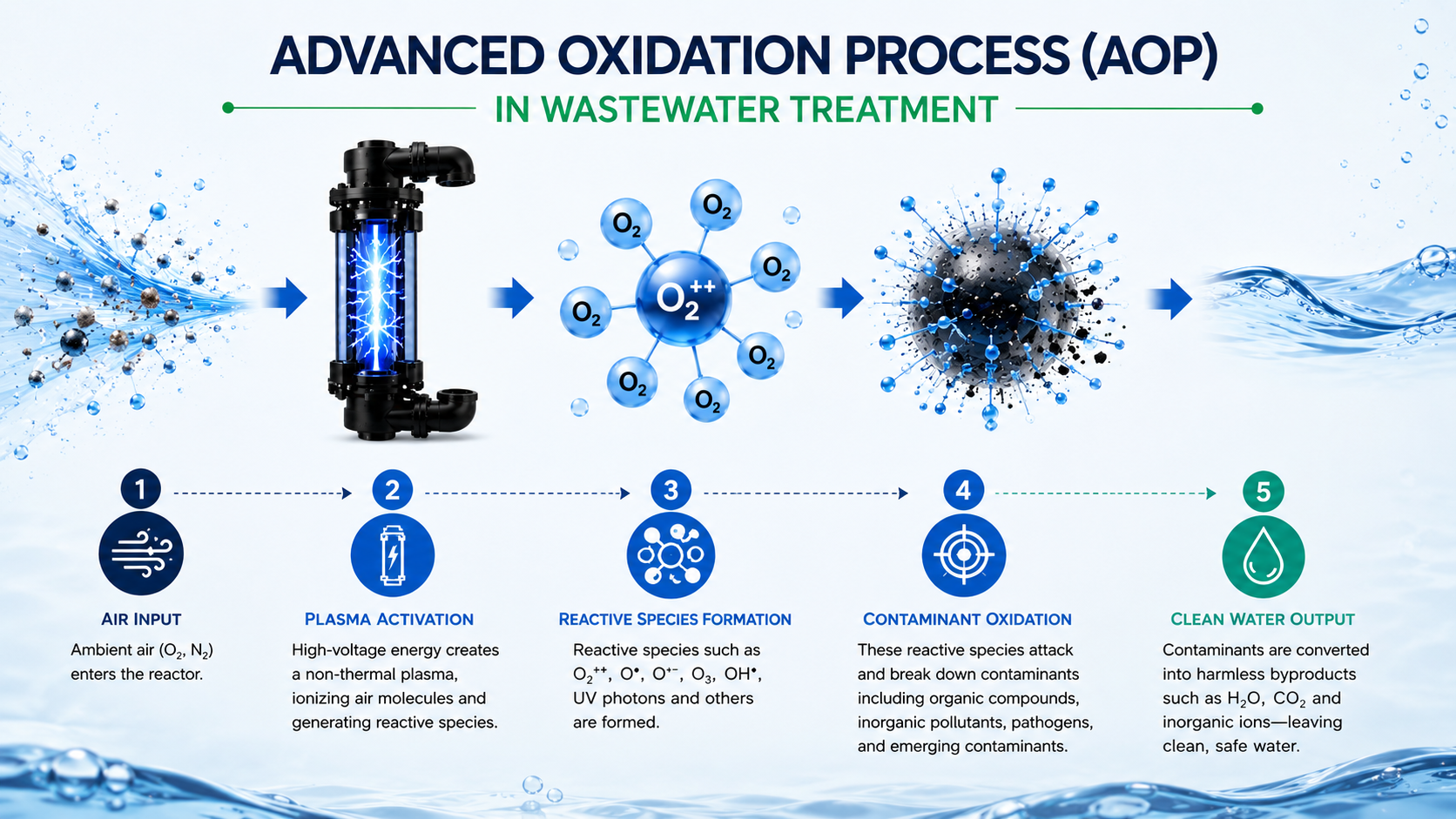
The performance of AOP in water treatment depends on the generation of reactive oxidation species.
The process generally follows these steps:
1. Pre-Treatment
Water is pre-conditioned by reducing suspended solids and adjusting pH.
2. Radical Generation
Oxidants or energy sources generate highly reactive species such as hydroxyl radicals, ozone, hydrogen peroxide, and other reactive oxygen species.
Examples:
UV activates hydrogen peroxide
Ozone decomposes into radicals
Plasma ionizes air/water to form oxidants
3. Pollutant Oxidation
Hydroxyl radicals attack contaminants by breaking chemical bonds, opening aromatic ring structures, reducing toxicity, and improving biodegradability.
4. Downstream Improvement
Post-AOP water becomes easier to treat using: Biological systems, RO systems, and Tertiary polishing units
This improves overall treatment efficiency.
Benefits of Advanced Oxidation Process (AOP)
1. Effective COD Reduction
One of the biggest advantages of AOP is strong COD reduction.
Industries often struggle with residual COD after biological treatment. AOP targets refractory contaminants that are not readily removed through biological treatment.
2. Better TOC Reduction
TOC reduction can improve treated water quality and reduce fouling potential in downstream treatment systems.
3. Treats Refractory Wastewater
AOP is highly effective for refractory wastewater treatment, especially where pollutants resist biodegradation.
4. Improves ZLD Performance
In Zero Liquid Discharge (ZLD) optimization, AOP reduces load on: RO, Evaporators and Crystallizers.
This may improve water recovery and reduce the operational burden on downstream thermal treatment systems.
5. Supports Water Reuse
AOP enables higher-quality treated water suitable for reuse and recycling.
Plasma Oxidation: The Next Generation of AOP
Among emerging AOP technologies, plasma oxidation is gaining major attention. Plasma-based AOP generates multiple reactive species, including hydroxyl radicals, ozone, hydrogen peroxide, and reactive oxygen species, which contribute to contaminant degradation. Unlike conventional oxidation methods that depend heavily on chemicals, plasma systems use electrical energy to generate reactive species.
Advantages of plasma oxidation include:
Lower chemical dependency
Compact footprint
Faster oxidation kinetics
Modular deployment
Easier integration
This makes plasma especially valuable for decentralized and industrial systems.
How SustainyX is Advancing AOP in Water Treatment
SustainyX, part of the SFC Group ecosystem, is building next-generation modular water treatment systems for industrial and municipal applications. SustainyX transforms breakthrough R&D into engineered, deployment-ready products designed for real-world challenges.
Its flagship C-ION™ platform uses plasma-based Advanced Oxidation Process (AOP) through PlasmaConnect™, engineered specifically for difficult water treatment challenges such as:
Residual COD & TOC reduction
ZLD optimization
Complex industrial wastewater treatment
Arsenic oxidation and treatment in drinking water applications.
Drinking water pre-treatment
For sectors dealing with difficult effluent streams, SustainyX provides a practical path toward: Environmental compliance, Operational efficiency and Long-term sustainability.
Why AOP Will Shape the Future of Water Treatment
Water scarcity, stricter regulations, and industrial growth are forcing businesses to rethink wastewater management. Conventional treatment alone is no longer enough.
Advanced Oxidation Process (AOP) is becoming a critical treatment stage for industries that need higher treatment performance and better water reuse.
For organizations facing difficult wastewater challenges, adopting advanced oxidation is increasingly becoming a strategic consideration for industries seeking higher treatment performance and water reuse.
And with innovators like SustainyX making AOP in water treatment more accessible through modular, high-performance systems, the transition to smarter water treatment is already underway.
Conclusion
If your plant is struggling with: Residual COD, Poor TOC reduction, ZLD inefficiencies, Difficult industrial wastewater, and Arsenic contamination
Then Advanced Oxidation Process (AOP) may be a valuable treatment stage to evaluate as part of your overall treatment strategy.
Modern water challenges require next-generation solutions, and companies like SustainyX are helping bridge advanced science with practical deployment.
FAQ’s
1. What is Advanced Oxidation Process (AOP) in water treatment?
Advanced Oxidation Process (AOP) is a treatment technology that generates highly reactive oxidizing species, such as hydroxyl radicals, to break down hard-to-remove contaminants in water and wastewater.
2. Where is AOP used in industrial wastewater treatment?
AOP is commonly used in industries such as:
Pharmaceuticals
Chemicals
Textiles
Dyes & pigments
Petrochemicals
It is especially useful for treating refractory wastewater with high COD and TOC.
3. Can AOP reduce COD and TOC?
Yes. One of the biggest advantages of AOP in water treatment is efficient COD reduction and TOC reduction, particularly for contaminants that biological treatment cannot remove.
4. Can AOP remove arsenic from drinking water?
AOP helps in arsenic removal from water by oxidizing dissolved arsenic into forms that are easier to remove via coagulation and filtration.
5. How is plasma oxidation different from conventional oxidation?
Plasma oxidation uses electrical energy to generate reactive species without heavy chemical dependence. Compared to traditional oxidation methods, it can offer:
Faster oxidation
Lower chemical use
Modular deployment
Easier plant integration
6. How does SustainyX implement AOP?
SustainyX uses its C-ION™ platform, powered by PlasmaConnect™, to deliver modular plasma-based AOP systems for industrial wastewater and drinking water applications. These systems are designed for COD reduction, ZLD optimization, and advanced oxidation challenges
7. What contaminants can AOP remove?
AOP can treat a wide range of contaminants, including refractory organics, dyes, solvents, pharmaceutical residues, pesticides, odour-causing compounds, and certain emerging contaminants.
8. Can AOP improve water reuse?
Yes. By reducing organic pollutants and improving water quality, AOP can support industrial water reuse and recycling initiatives.
9. Is AOP suitable for Zero Liquid Discharge (ZLD) systems?
Yes. AOP can reduce the pollutant load entering RO systems, evaporators, and crystallizers, helping improve ZLD performance.
10. Does AOP generate sludge?
Most AOP technologies generate significantly less sludge compared to conventional chemical treatment processes.
11. What is the role of hydroxyl radicals in AOP?
Hydroxyl radicals are highly reactive oxidizing species that attack and degrade contaminants at the molecular level.
12. Can AOP be integrated into existing ETPs?
Yes. AOP systems can often be added as a pre-treatment, intermediate treatment, or polishing stage within existing wastewater treatment infrastructure.
13. What are the advantages of plasma-based AOP?
Plasma-based AOP can generate multiple oxidizing species simultaneously, reduce chemical dependency, and offer modular deployment for industrial applications.